Scheduling Complex Events: From NFL Games to Kidney Transplants and Flight Crews
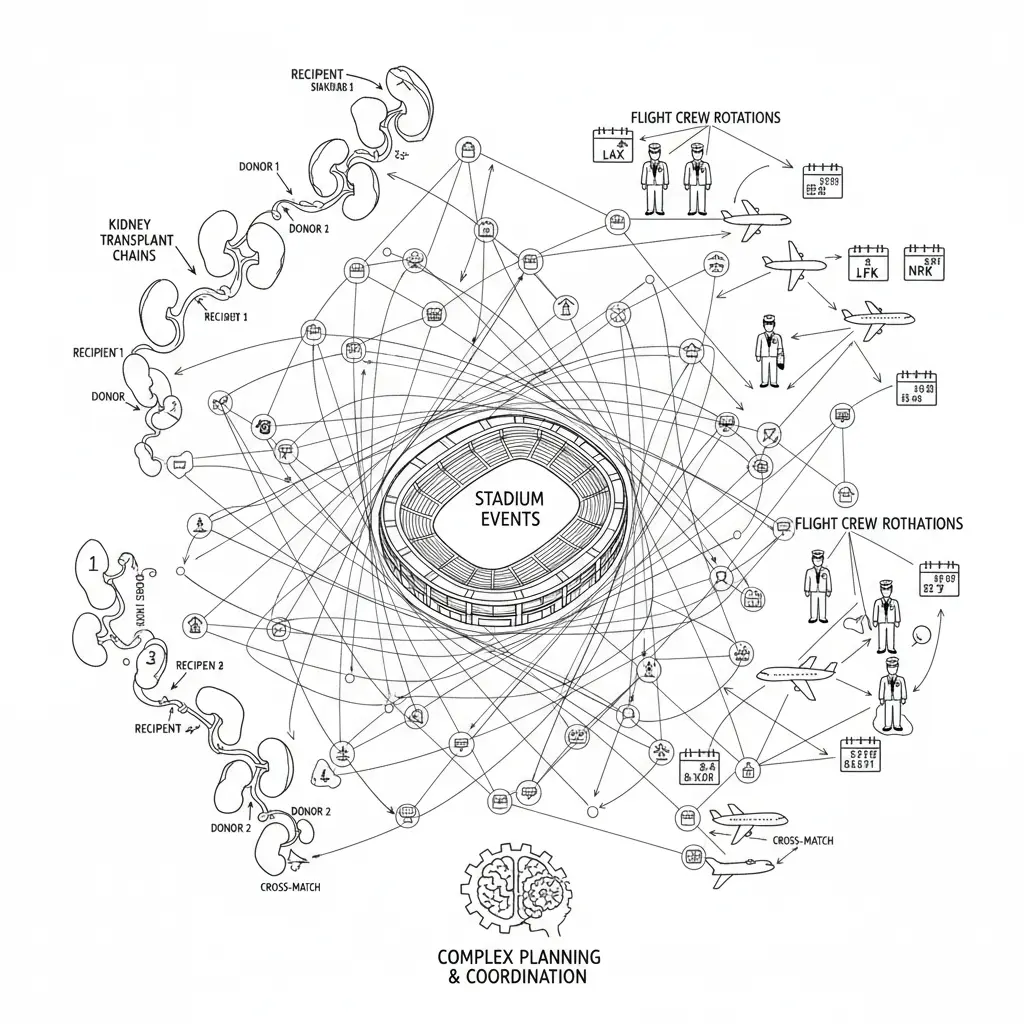
Scheduling large-scale events and critical operations involves managing many constraints to prevent conflicts and maintain smooth flow. This text covers how the NFL arranges game dates around major concerts, how kidney transplant chains coordinate donor kidneys, and how airlines organize flight crews under regulatory limits.
- The NFL arranges stadium use to avoid overlapping with major concerts like Beyoncé’s.
- Kidney transplant chains link donor-recipient pairs to extend the use of one kidney to multiple patients.
- Airlines assign crews while following rest rules and adapting to flight schedule changes.
Coordinating NFL Games with Stadium Events
The NFL schedules games in venues that also host major concerts and other events, requiring coordination to prevent overlaps. Collaboration with stadium managers and event planners occurs well ahead of time.
Shared scheduling tools mark dates reserved for concerts, including performances by artists such as Beyoncé, so games avoid those periods. Additional buffer days accommodate event setup and breakdown without interfering with football matches.
Scheduling systems integrate multiple considerations like team travel, broadcast windows, and venue availability to keep the NFL season running without conflicts.
Extending Kidney Transplants Through Donor Chains
Because donor kidneys are scarce, transplant programs use chains that connect compatible donor-recipient pairs in a sequence of operations. This approach leverages one donation to benefit multiple patients.
Typically, a donor gives a kidney to a compatible recipient whose own donor then donates to another patient, continuing the sequence. Optimization models help plan these chains by analyzing compatibility, timing, and logistics.
This scheduling method increases transplant opportunities, illustrating how precise coordination can support complex medical procedures.
Scheduling Flight Crews Under Regulatory Constraints
Airlines face strict rules on crew rest and maximum duty hours, making crew scheduling a complex task. Systems assign crews to flights while respecting these regulations.
Specialized software balances crew availability, flight timings, and mandatory rest periods to maintain compliance and reduce delays. The scheduling process must adapt quickly to changes like delays or cancellations.
Flexibility in updating crew assignments helps airlines manage operations while adhering to safety and legal standards.
Computational Methods in Scheduling Optimization
Many complex scheduling problems use mathematical optimization techniques such as linear programming to find solutions that satisfy multiple constraints. These methods support decision-making in diverse fields.
Recent developments include leveraging GPUs to accelerate computations. For example, NVIDIA’s cuOpt software applies the barrier method to speed up solving linear programs, allowing faster schedule adjustments.
This computing capability is valuable when schedules require frequent updates or must consider numerous variables simultaneously.
Limitations and Challenges in Complex Scheduling
Even with advanced tools, some scheduling tasks remain challenging due to conflicting constraints or unexpected changes. Manual adjustments may be necessary when automatic solutions cannot accommodate all factors.
When not all constraints can be met, prioritization and approximate scheduling approaches are used. Human oversight continues to be important in navigating these complexities effectively.
- Coordination across multiple stakeholders can introduce delays or communication gaps.
- Unexpected events may disrupt planned schedules, requiring rapid re-evaluation.
- Optimization models depend on accurate data and assumptions that may not always hold.
- Balancing competing priorities often involves trade-offs that software cannot fully resolve.
Summary of Complex Scheduling Considerations
Managing schedules for NFL games, kidney transplant chains, and airline crews involves balancing many constraints and stakeholders. Software and computing resources assist with optimization but do not replace human judgment.
Understanding the capabilities and limits of scheduling approaches is important for handling the complexity inherent in these diverse applications.
Comments
Post a Comment